Connected medical devices
Blood pressure, SpO2, temperature, glucose, weight, ECG and more — cellular, Bluetooth or Wi-Fi — feeding one monitoring layer.
Remote patient monitoring (RPM) lets care teams collect vital signs and symptoms outside the ward — at home, in the community, or on the go — and act on them from one clinical dashboard. SmartFuture is a remote patient monitoring platform provider for Singapore and US programmes: connected devices, configurable alerts, patient communication, white-label apps and EHR/EMR integration.
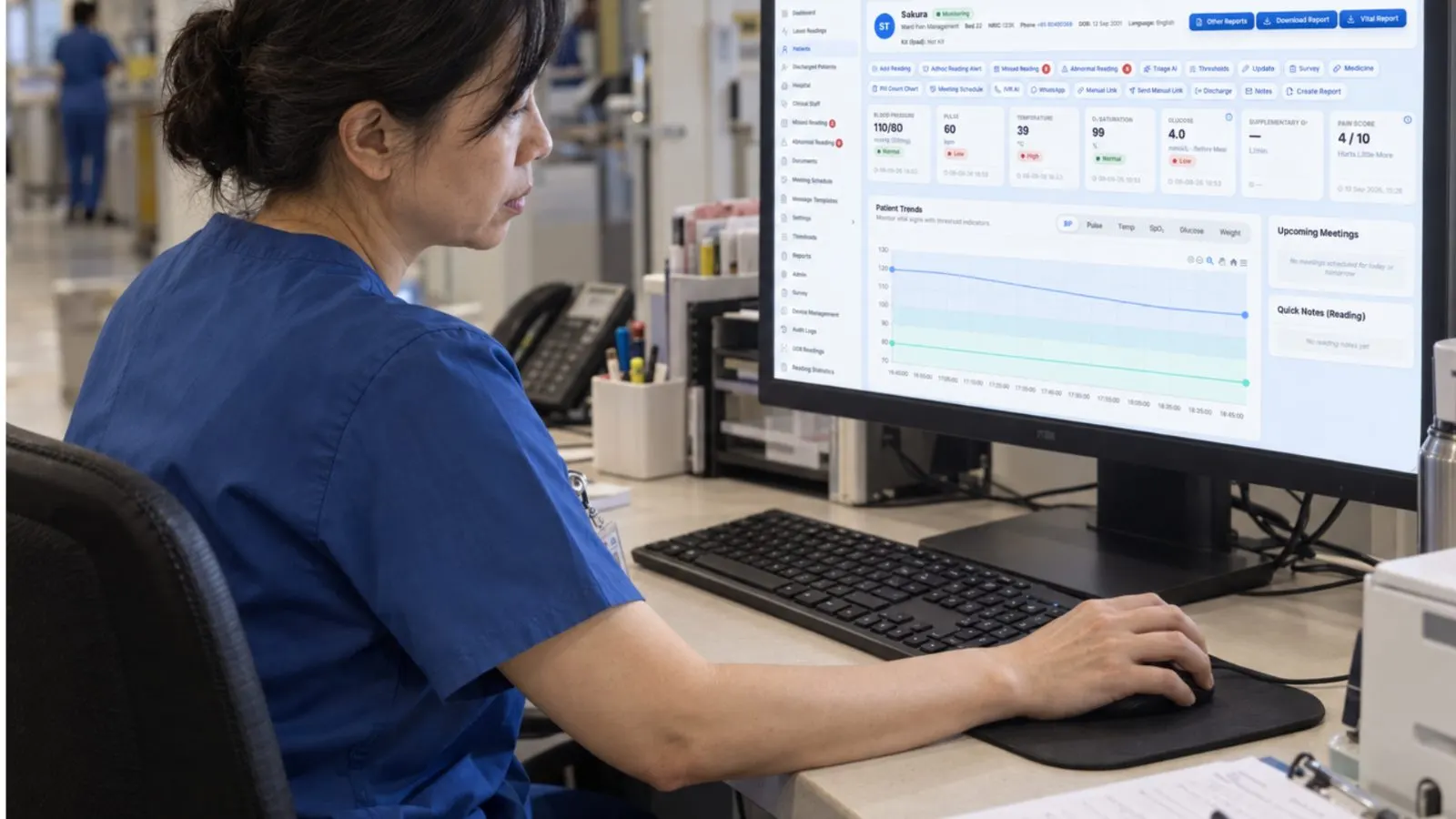
Remote patient monitoring (RPM) is the use of connected medical devices and clinical software to collect vital signs, symptoms and adherence data outside traditional care settings — then route that information to clinicians for review, alerting and follow-up. Unlike a one-off teleconsult, RPM is designed for ongoing visibility between visits.
A production RPM programme typically combines four layers: devices that capture the reading; a patient experience that makes capture reliable; a clinician dashboard with thresholds and escalation; and integrations that keep the EHR or EMR complete. SmartFuture delivers those layers as a white-label stack that hospitals, clinics and facility operators can host under their own brand and infrastructure rules.
Device choice follows the pathway. Hypertension and heart-failure programmes often centre on blood pressure and weight. Respiratory pathways add SpO2 and temperature. Diabetes programmes need glucose capture that patients will actually complete. Connectivity matters as much as the sensor: home Wi-Fi cannot be assumed for elderly or maritime populations, so cellular and kit-based capture remain core options.
Software decides whether those readings become work. Care teams need a prioritised patient list, configurable protocols, documentation that fits existing notes, and teleconsult in context when a reading crosses a threshold. See RPM software, RPM devices and RPM platform for the distinct buying angles.
Providers evaluate RPM against local privacy and medical-device expectations. In Singapore that includes PDPA handling and HSA considerations for devices and intended use. In the United States, programmes often map to HIPAA operational controls and FDA-cleared device choices where applicable. SmartFuture is built for providers who need white-label experiences and hosting options aligned to their compliance and IT requirements rather than a shared consumer brand.
Reimbursement and commissioning models vary by market and payer. The practical path is the same: define the cohort and protocol, confirm device connectivity, integrate identity and EHR where required, train the reviewing team, then run a time-boxed pilot before scaling. Most SmartFuture pilots move from discovery to live monitoring in weeks when the pathway and hosting model are clear — not months of custom engineering for a first ward or clinic.
For evaluation help, use the RPM vendor checklist and compare white-label vs off-the-shelf RPM.
A complete RPM programme is more than a device. It is the workflow that connects the patient, the reading and the care team.
Blood pressure, SpO2, temperature, glucose, weight, ECG and more — cellular, Bluetooth or Wi-Fi — feeding one monitoring layer.
Review readings, trends and alerts in one place. Prioritise patients who need follow-up without opening five systems.
Tablet kits, simple web links or WhatsApp-friendly capture so patients can submit readings without a complex app install.
Thresholds set by your clinicians. Notifications when readings need review, not vanity notifications.
Keep the hospital or clinic record complete with supported real-time integration.
Run the programme under your brand and hosting model — not a shared multi-tenant marketing portal.
Choose the patient group, devices, reading schedule and alert rules that match your protocol.
Deploy a connected kit or a bring-your-own-device link. Train patients and caregivers on one simple flow.
Care teams review the dashboard, respond to alerts and document follow-up in your existing workflow.
Start with one ward, clinic or disease cohort, then expand across sites and programmes on the same platform.
Hospitals use RPM for hospital-at-home and post-discharge pathways. Clinics use it for chronic disease follow-up between visits. Nursing homes and home healthcare teams use it for visibility across residents. Employers and insurers use screening and ongoing monitoring programmes built on the same stack.
Related pages: Hospital at Home, Chronic Disease Management, RPM Platform, RPM Devices, and EHR/EMR Integration.
Remote patient monitoring is the use of connected devices and software to collect health data outside traditional care settings and share it with clinicians for review, alerts and follow-up.
No. Telehealth is typically a visit. RPM is continuous or scheduled monitoring between visits — often with devices that send readings automatically.
Yes. SmartFuture supports white-label patient and clinician experiences and can be hosted in line with your infrastructure requirements.
Tell us your care setting, devices and EHR. We will map a pilot pathway.
Prioritise alerts and trends with clinicians in control.
Singapore hospital-at-home monitoring programmes.
RPM when home Wi-Fi cannot be assumed.